Start a Circle 9 min read
What Is a Giving Circle? A Guide for Nonprofits
You probably already have a giving circle. It just doesn’t know it yet. Look through your donor list and you’ll find them: the monthly donors who have given for six straight years, the young professionals who come to every happy hour, the alumni, the parents, the women who keep showing up for the same program. […]
Updated October 14, 2026 · Swell Circles
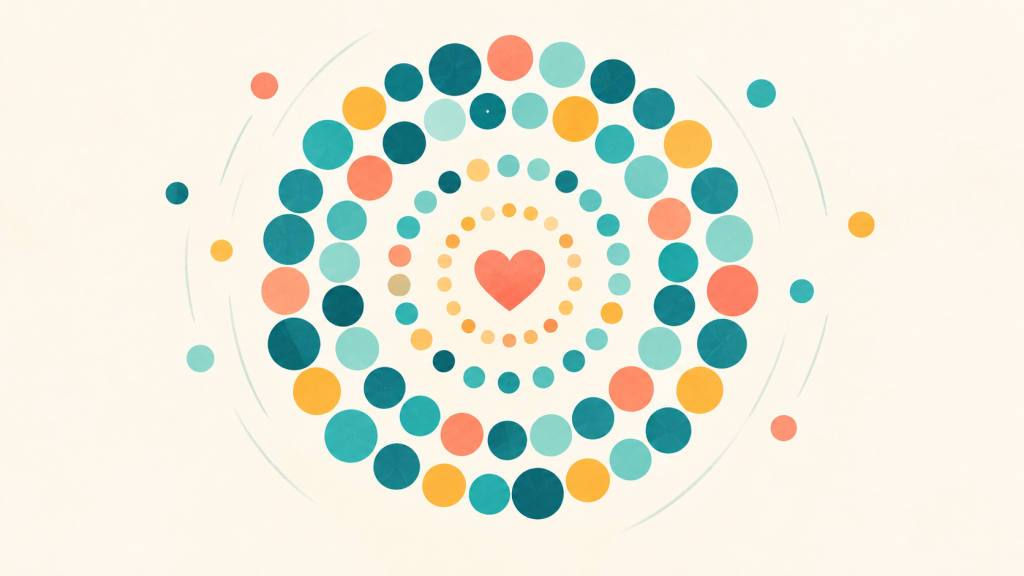
You probably already have a giving circle. It just doesn’t know it yet.
Look through your donor list and you’ll find them: the monthly donors who have given for six straight years, the young professionals who come to every happy hour, the alumni, the parents, the women who keep showing up for the same program. They share something real with each other and with your mission. In most databases, though, they live as a tag, a segment, or a recurring transaction. Nothing about their experience tells them they’re part of a group.
A giving circle changes that.
What a giving circle is
A giving circle is a group of donors who give, and belong, together. When a nonprofit hosts one, it creates the circle around its own mission: a program, an affinity, or a shared purpose. Members join at a giving level, contribute monthly or annually, and share experiences that connect them to the work and to each other.
Giving circles are part of a larger movement called collective giving, where people pool their resources to make a bigger difference than any one of them could alone. Philanthropy Together, a national nonprofit that helps people start and sustain circles, is a good place to see the breadth of the movement.
Many of the earliest circles were independent groups of friends who pooled money and chose a cause each year. The model we focus on starts from the other direction. Your nonprofit defines what the circle funds before the first member joins, so every dollar is committed to your mission from day one. That one shift turns a circle into something a development team can plan around, forecast, and grow.
What a nonprofit-hosted circle looks like
Most circles share five ingredients:
- A clear purpose. The circle funds something specific: a program, a campus, a season of work, or your whole mission seen through the eyes of one community.
- Membership levels. Members choose a level with its own dues and benefits, paid monthly or annually. Three levels is usually plenty.
- A volunteer chair. One or two members who welcome newcomers, host gatherings, and invite their friends. The chair is the circle’s heartbeat.
- Gatherings. A site visit, a dinner, a briefing with program staff, a field day. Circles run on getting together.
- Communication that feels like membership. Updates, impact reports, and invitations meant for this group, not your whole list.
Here’s a sample we use often. A coastal conservation group creates the Ocean Stewards circle to fund its shoreline restoration program. Members join as a Friend at $25 a month, a Steward at $100 a month (which adds a vote on the quarterly project and a field day with the restoration crew), or a Guardian at $1,000 a year (which adds recognition on the shoreline marker and a seat at the planning table). Eighty-six neighbors join, gather each season, and watch the dunes get replanted in front of them.
Real examples are everywhere once you start looking. The Heartful Women’s Giving Circle at Trenton Memorial Hospital asks members for $365 a year, framed as “$1 a day.” Members gather several times a year and vote on which piece of priority medical equipment the circle funds.
That vote is worth a closer look, because it’s the question boards ask first. In a nonprofit-hosted circle, member decision-making is optional. You might let members choose among three of your programs or pick which project the next quarter’s dues fund. It’s an engagement tool you decide to turn on, never a condition of the model. The money is committed to your mission either way.
A circle is more than a recurring giving program
Recurring giving is a payment schedule. A giving circle is a group of people who know they’re in it together.
That difference matters more than it sounds. A monthly donor who cancels makes a private, frictionless decision that nobody notices. A circle member who leaves is stepping away from people they know, a chair who invited them, and a project they’ve watched move forward. The dues may look identical on a transaction report. The relationship behind them is not.
A circle also gives you structure most recurring programs lack: a name members can say out loud, a reason to invite a friend, and a clear next level to grow into.
Why giving circles are good for nonprofits
Most nonprofits are raising more money from fewer people. The Fundraising Effectiveness Project found that dollars raised grew about 5% in 2025 while the number of donors fell 3.6%, extending a decline that began in 2021. Overall donor retention was 43.3%. Put plainly, more than half of the people who give to you this year won’t give next year.
Circles answer that problem in five ways.
1. Members stay. Recurring donors already retain far better than one-time donors. Neon One’s 2026 Recurring Donor Report puts recurring donor retention near 79%, compared with about 32% for one-time donors. A circle adds what a payment schedule can’t: belonging. Leaving stops being a silent decision.
2. Members grow. In a 2009 study of giving circle members, researchers Angela Eikenberry and Jessica Bearman found that 66% of members said their giving increased because of their circle. Average annual giving also rose with time in a circle: about $3,682 for first-year members, $9,531 at three to four years, and $12,328 after five years. The research is correlational and covers many kinds of circles, so read it as a direction rather than a promise. It’s the direction every development director wants.
3. Revenue gets predictable. Dues at set levels and frequencies are something you can forecast, budget against, and report to your board with confidence.
4. Members invite people you can’t reach. A chair’s text to a friend lands with people your email list never will. Circles are one of the few acquisition tools where your best donors do the inviting.
5. Members give more thoughtfully. The same study found circle members were more likely to research organizations, check performance data, and think about the change they want their giving to create. Those are the donors who eventually make major gifts. When a member moves from your $25 level to your $1,000 level, that’s an honest signal of readiness.
Collective giving is growing fast
Giving circles are one of the fastest-growing forms of philanthropy in the United States. In Abundance, the 2024 landscape study from the Dorothy A. Johnson Center for Philanthropy, Colmena-Consulting, and Philanthropy Together, tracks the growth. As Axios reported, collective giving groups and their membership roughly tripled between 2007 and 2016, then tripled again by 2023. That adds up to about 4,000 groups and 370,000 members, who gave more than $3 billion in the five years ending in 2023. The researchers expect the movement to double again within five years.
Two details in that research matter for nonprofits. First, most members give less than $1,000 a year, so circles are an entry point for everyday donors, not a club for the wealthy. Second, the study looked specifically at nonprofit-led circles and at groups formed to support a host organization. Nonprofits running their own circles are already part of this landscape.
Set the two trends side by side. Fewer people are giving to nonprofits overall, while more people are joining giving circles. Circles are where a growing number of donors are choosing to show up.
Why circles are hard to run, and where Swell Circles comes in
If circles work this well, why doesn’t every nonprofit run three of them? Because running one by hand is a grind. Most circles live on a spreadsheet, a payment link, and a lot of staff time:
- Billing gets messy fast. Mixed levels, monthly and annual dues, and every member on a different renewal date. Most donation tools only understand “one-time” or “recurring,” so renewals turn into reminders, invoices, and chasing expired cards.
- Communication scatters. There’s no easy way to email just this circle, just one level, or just the members who haven’t renewed. It becomes a BCC from someone’s inbox, with nothing logged.
- Members don’t feel like members. They get the same donation form, receipt, and year-end letter as everyone else.
- Chairs depend on staff. A volunteer can’t check a roster or welcome a new member without asking someone for a report.
Swell Circles is built to take that work off your team. Each circle gets its own branded public page with your photos, story, colors, live progress, and the members already in it, so joining feels like joining something rather than filling out a form. You set as many membership levels as you need, each with its own dues, billing frequency, and benefits. Monthly and annual dues are charged automatically and settle directly into your own Stripe account, with card updates, failed-payment retries, and receipts handled for you. Renewal tracking shows who’s active, who’s due, and who’s lapsing, before they lapse.
Communication lives in one place. Email the whole circle, a single level, or only the members who haven’t renewed, with every send logged on the member’s record. Volunteer chairs get access to their own circle’s members and tools without seeing the rest of your database. Gatherings, transactions, and reporting stay attached to the circle, and everything exports cleanly to your CRM and your board packet.
Keep reading
Sources and further reading
- In Abundance: An Analysis of the Thriving Landscape of Collective Giving in the U.S., Johnson Center for Philanthropy, Colmena-Consulting, and Philanthropy Together, 2024
- Why giving circles are the fastest-growing form of philanthropy right now, Axios, April 2024
- The Impact of Giving Together, Angela Eikenberry and Jessica Bearman, 2009
- Fundraising Effectiveness Project Q4 2025 results, Association of Fundraising Professionals, April 2026
- Recurring giving statistics, Neon One, 2026
- Philanthropy Together, national resource for giving circles